
Last updated September 20, 2026
Free on-site gate assessment - hinges, posts, and your LiftMaster or Nice gate operator checked before anything is quoted
The assessment is free and the quote is the invoice.
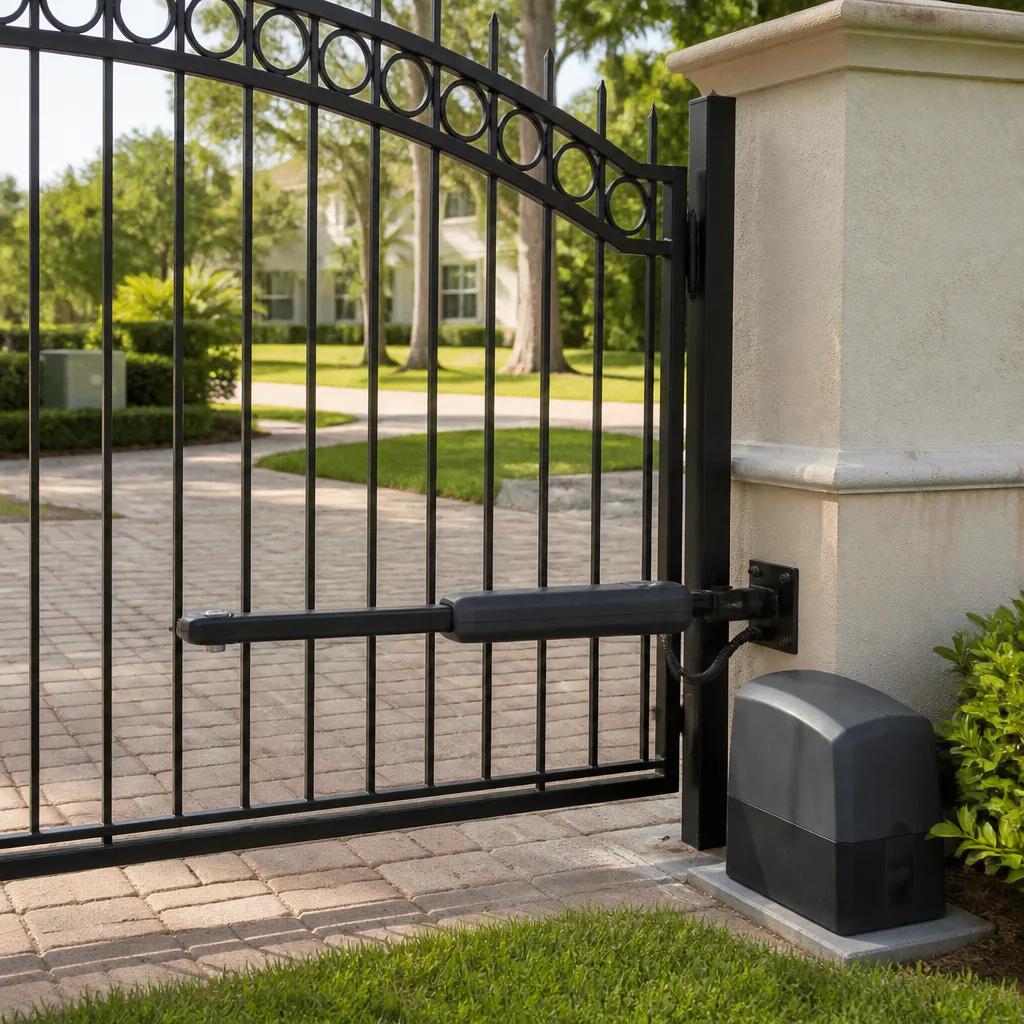
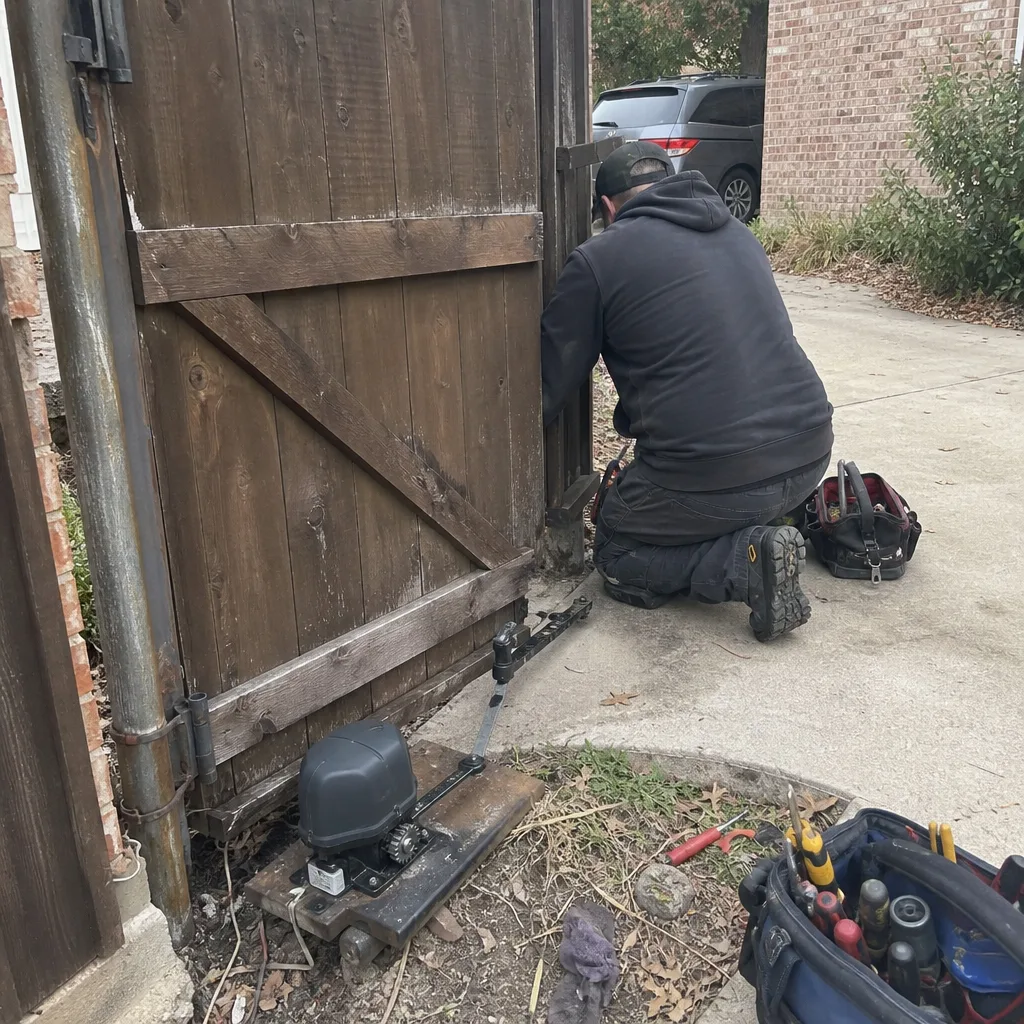 Before
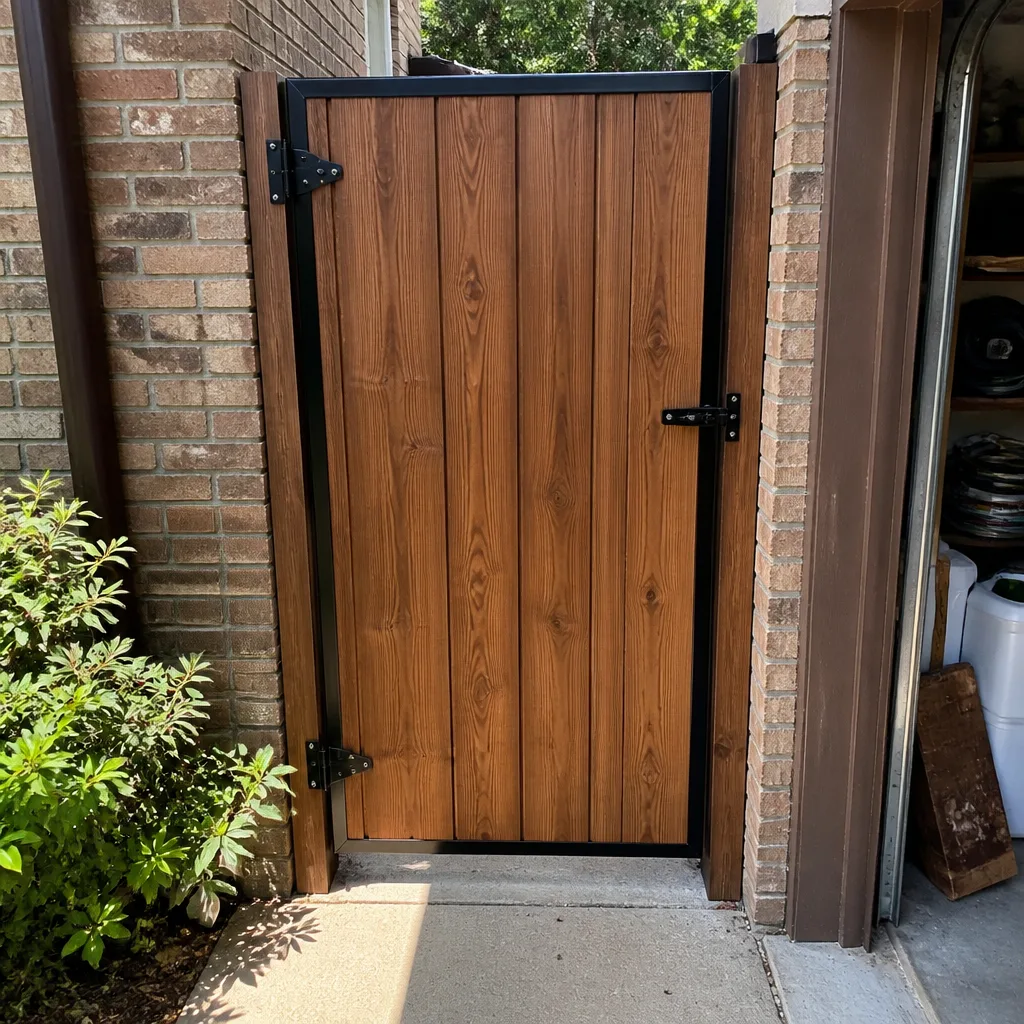 After
After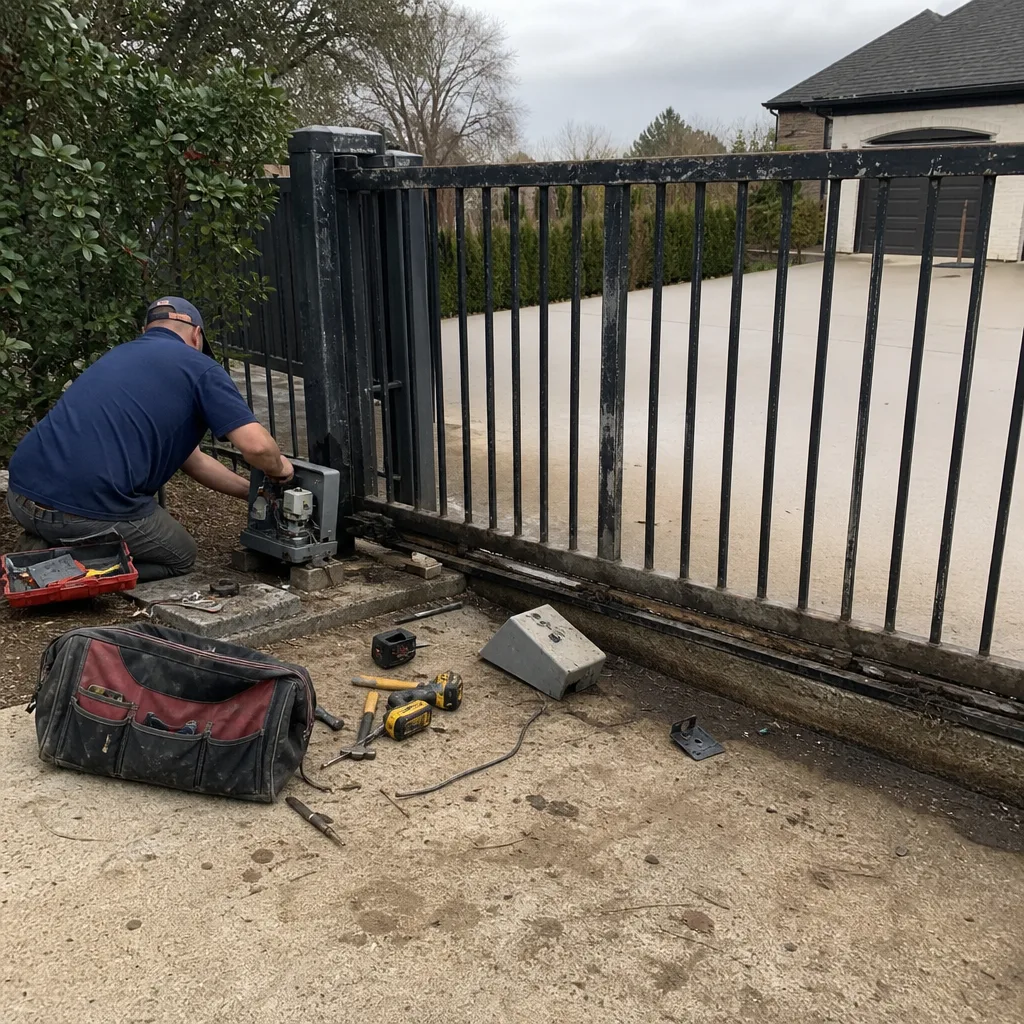 Before
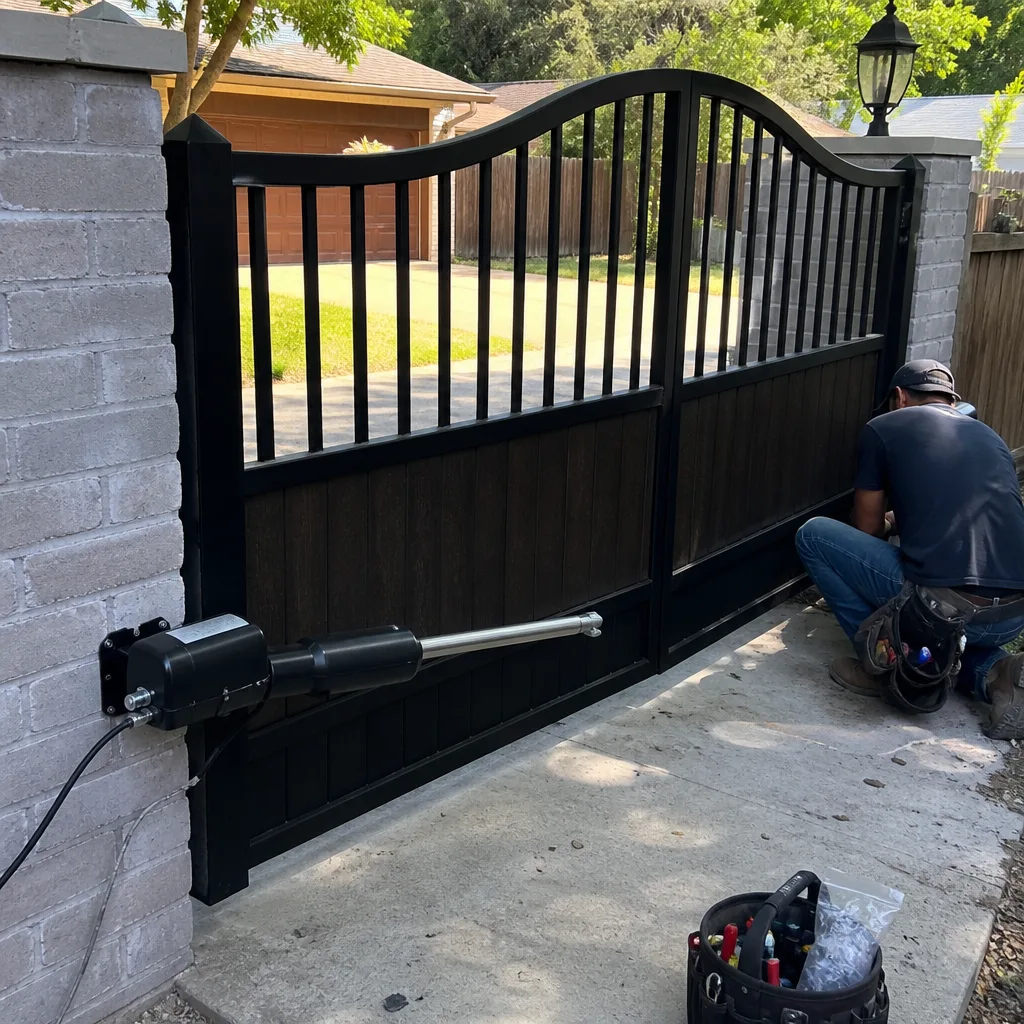 After
After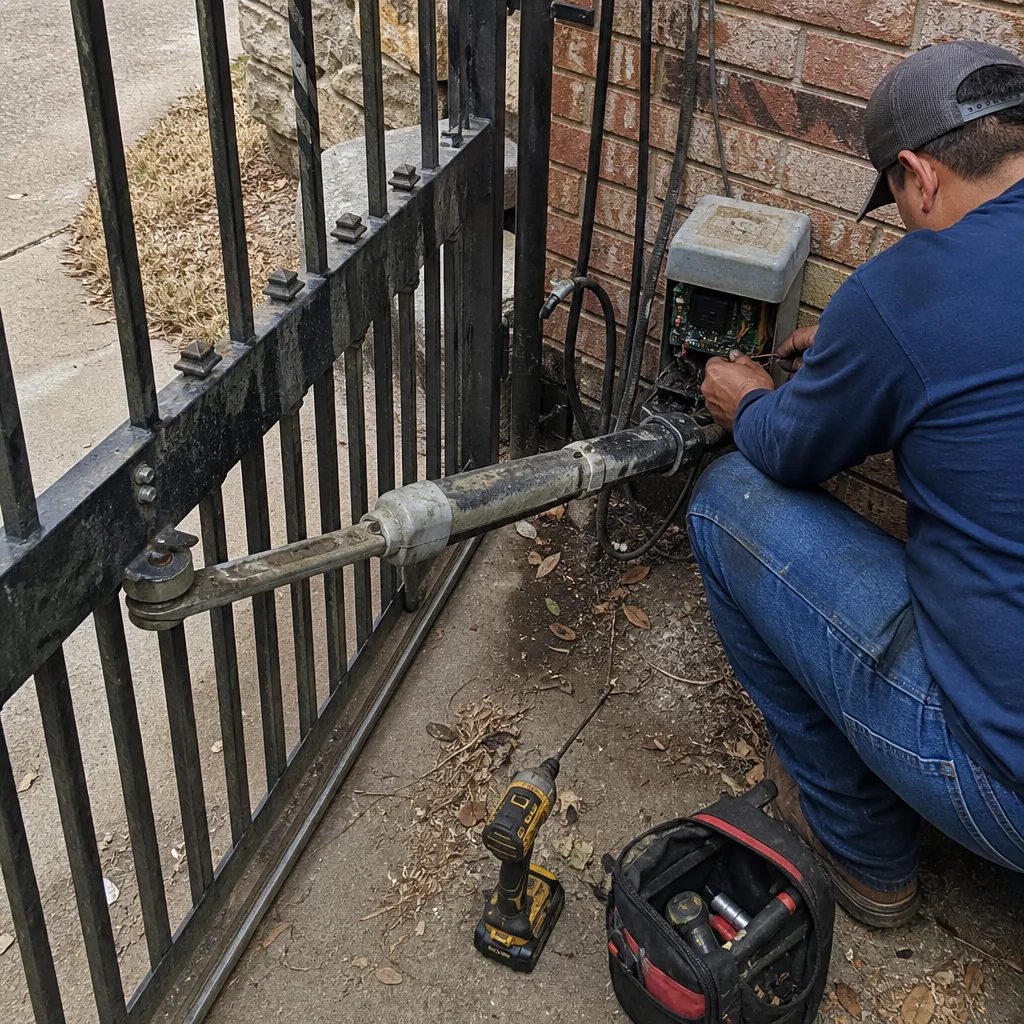 Before
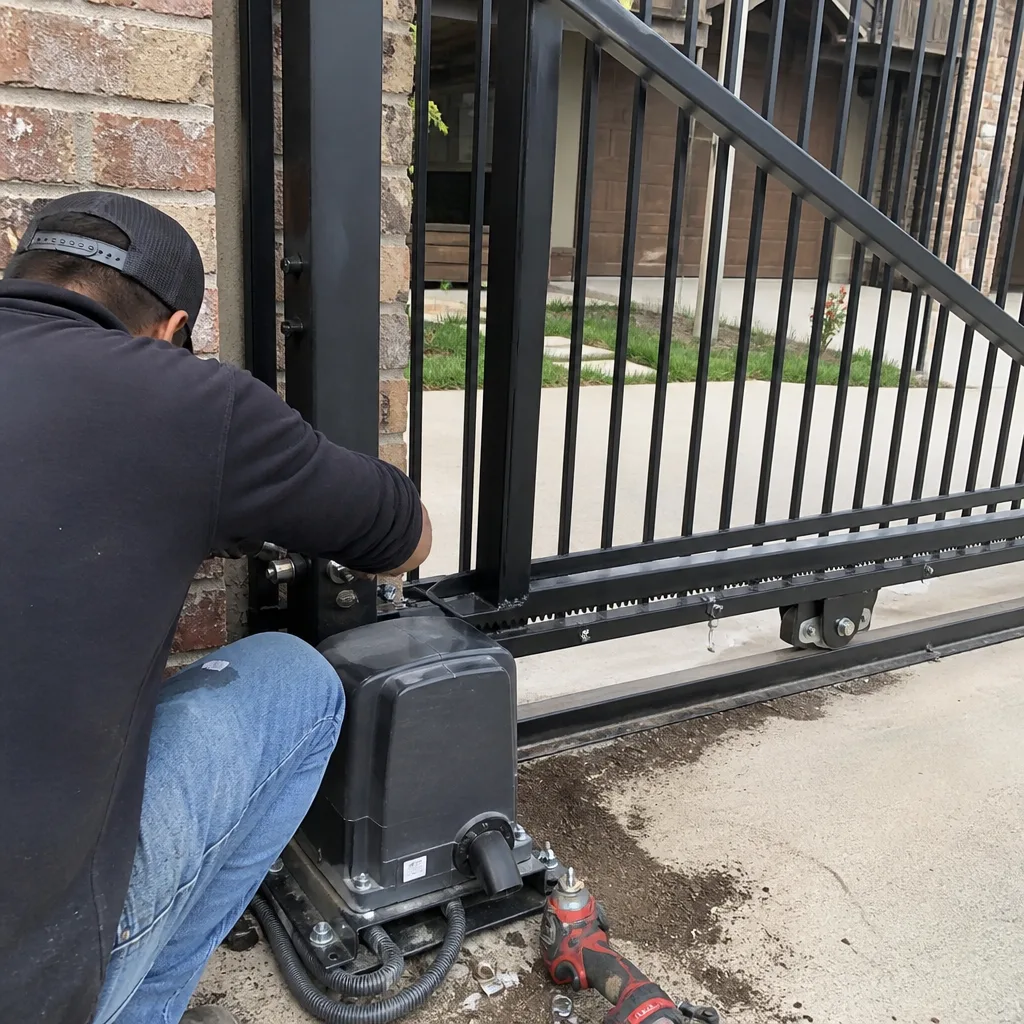 After
AfterGate Repair Warning Signs: A Coppell Homeowner’s Reference Guide
Most gate warning-sign guides treat every symptom as if it carries the same weight. A slow gate and a gate that reverses itself onto a car hood get listed side by side, as if calling a technician next Tuesday is an acceptable response to both. It isn’t. Under UL 325, the safety standard governing automated gates in the United States, an uncontrolled reversal is an entrapment hazard that can injure a person or destroy a vehicle within a single operating cycle. This guide ranks the warning signs by severity, tells you which tier means stop using the gate now versus which means log it and watch, and explains how Coppell’s soil conditions create one failure pattern most national guides never mention. By the end, you’ll know what to photograph on your phone before you call anyone, what a written estimate should cover, and which symptoms you can safely monitor for a few weeks. For more guides & resources, visit our blog.
Quick Answer
The most urgent gate repair warning signs in Coppell are uncontrolled reversal, failure to stop at end of travel, and a photo-eye or contact sensor that no longer detects obstructions. Those three mean stop using the gate immediately and call a technician. Slower-than-normal cycle time, increased motor noise at startup, and superficial rust are lower-urgency issues you can log and monitor, but resolving them early prevents the $400 to $900 motor replacements that follow neglected symptoms.
Table of Contents
- Tier 1: Stop Using the Gate Now
- Tier 2: Schedule Within 7 Days
- Tier 3: Log and Monitor
- How to Document a Warning Sign With Your Phone
- The Coppell Caliche Problem: Post Lean and Limit-Switch Drift
- What Coppell Gate Repairs Typically Cost
- Common Mistakes to Avoid
- When to Call a Professional
 Before
 After
AfterTier 1: Stop Using the Gate Now
Tier 1 symptoms carry immediate safety consequences. If your gate exhibits any of the following, disconnect the operator from power and lock the gate in a fixed position until a technician arrives. Do not attempt to run the gate through another cycle to confirm the behavior. One confirmation cycle is how vehicles get dented and fingers get caught.
Uncontrolled Reversal
A gate that reverses direction after closing, or that begins to close and then unexpectedly opens again, is behaving like an entrapment event is occurring when none is. The operator interprets resistance as an obstruction and reverses. Sometimes a real obstruction is present, but when the gate reverses with nothing in its path, the force-sensitivity circuit is misreading its own motor current, or the limit settings have drifted.
We’ve diagnosed this in Coppell homes where the gate had been installed years earlier and never re-torqued after the first summer. The motor’s current draw increases as the gate binds, and the operator reverses because it believes a child is in the path. The safety system is doing its job, but the underlying bind needs correction before the gate closes reliably again.
Failure to Stop at End of Travel
When a slide gate runs to the end of its rail and keeps pushing, or a swing gate slams against its open stop and the motor continues humming, the limit switch has failed or drifted. Limit switches tell the motor where the gate’s travel ends. A gate that ignores them will eventually damage its own gearbox, the rack, the hinge plates, or the post itself.
In a worst case, the gate over-travels the open position on a swing installation and tears the bracket anchors loose from the masonry column. That repair often exceeds $1,200 in Coppell because the column must be re-anchored and the gate re-hung before the operator can be recalibrated.
Photo-Eye or Contact Sensor Failure
The photo-eye is the infrared beam across the gate opening. The contact sensor is the rubber edge strip on the gate’s leading edge. Both exist to stop or reverse the gate when something enters the entrapment zone. If either stops functioning in Coppell, the gate violates UL 325 entrapment-protection requirements and should not be operated.
We see photo-eye alignment drift in Coppell’s summer heat when gate frames expand. The beam, sized for a millimeter of tolerance, shifts out of alignment and the operator’s safety circuit returns an open fault, which disables the gate. If the homeowner bypasses the fault or the operator lacks a monitoring circuit, the gate continues running without entrapment protection.
Testing is simple: block the beam with your hand while the gate is closing. The gate should stop or reverse within one second. If it keeps closing, the sensor is dead or bypassed, and that gate is not safe to operate.
Tier 2: Schedule Within 7 Days
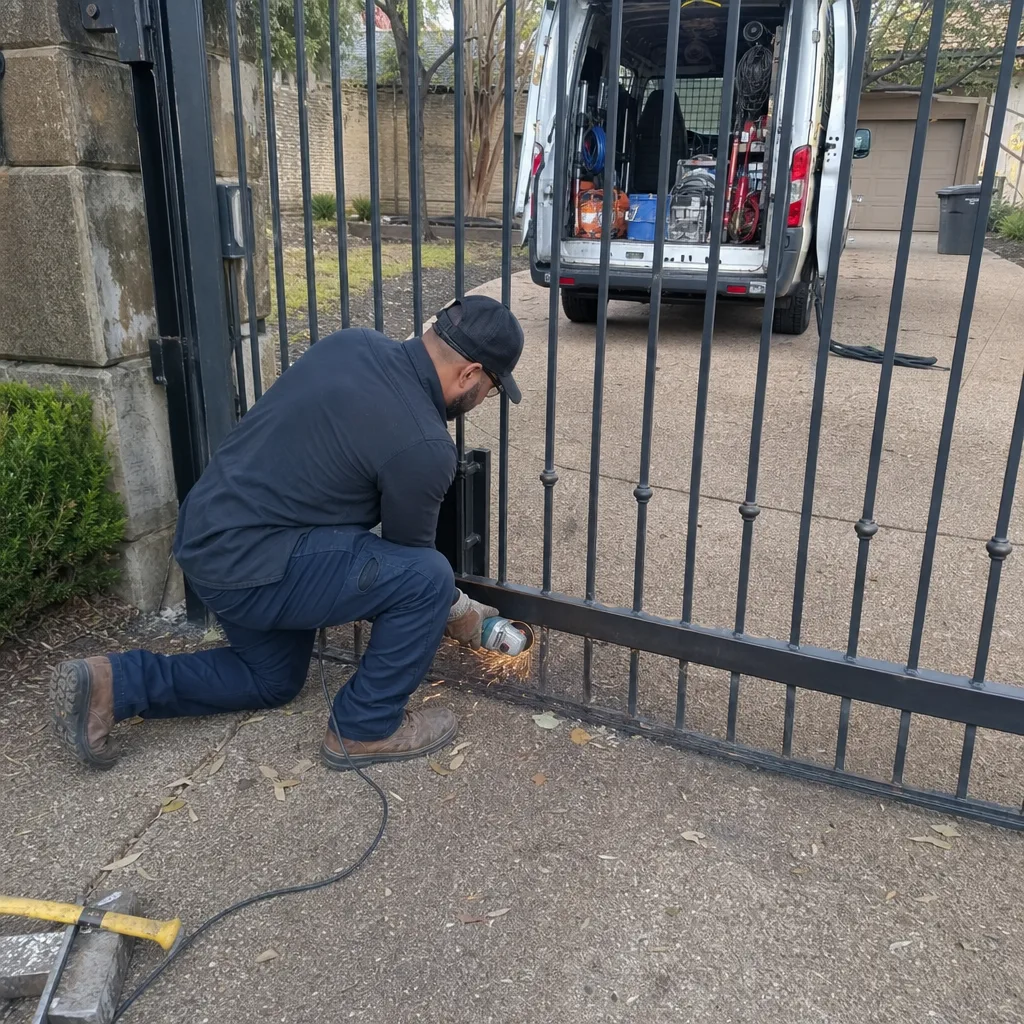
Tier 2 symptoms won’t injure anyone tomorrow, but they indicate a mechanical or electrical problem actively degrading. Scheduling within a week prevents a $200 repair from becoming a $900 component replacement.
Erratic Remote Response
You press the remote from the same spot where it has always worked, and nothing happens. You press again. The gate opens. Or the gate opens when you’re thirty feet farther away than you used to be, but only when the remote is held at chest height. That inconsistency points to one of three things: a failing receiver board, a remote battery at end of life, or radio interference from a nearby source.
In Coppell, the interference culprit we trace most often is a neighboring home’s newly installed smart-home hub or a security camera system broadcasting on overlapping 433 MHz or 318 MHz frequencies. LiftMaster operators, common throughout Coppell, use 315 MHz. When a neighbor installs a competing transmitter, your remote’s signal gets stepped on. A technician can diagnose this with a spectrum check and often resolves it by changing the remote channel, though complete fixes sometimes require a receiver swap.
Visible Weld Crack at the Hinge Plate
The hinge plate connects the gate leaf to the post. It carries the gate’s entire weight through every open-close cycle. A visible crack in the weld or in the plate itself is a fracture waiting to complete. Swing gates in Coppell typically cycle between 40 and 50 times per week for a two-car household. A cracked hinge plate can fail without additional warning, dropping the free leaf onto whatever is beneath it.
We photograph hinge plates on every service visit because a crack that’s visible today is usually preceded by rust blooms or paint delamination that were visible months earlier. The repair is a weld, often a reinforcement plate, and a post-alignment correction. That work runs $350 to $650 depending on whether the gate must be unshipped and re-set.
Control Board Error Codes
Modern operators, from brands like FAAC and BFT, flash error codes through an LED on the control board. The code is assigned meaning in the installation manual. A recurring code, even if the gate appears to operate normally, indicates a condition the board is tolerating but flagging. Common ones we see in Coppell: overcurrent events from binding hardware, undervoltage from a transformer nearing failure, and safety circuit timeouts from a photo-eye that realigns itself intermittently.
When you see a code, photograph it. Then look it up in the manual for your specific operator. If the manual is gone, the model number is printed on the board and any technician can identify what the code means before they arrive. Documenting the code speeds the diagnosis and reduces the time spent on-site.
Tier 3: Log and Monitor
Tier 3 symptoms are early-stage indicators. They don’t require an immediate service call, but they do require attention. A homeowner who logs these and compares them month over month is far ahead of one who ignores them until the gate fails outright.
Slower-Than-Baseline Cycle Time
Your gate used to cross its full travel in about 18 seconds. Now it takes 22 or 25 seconds. The deceleration is gradual enough that you almost didn’t notice it. But it’s real, and it means resistance somewhere in the system is increasing. The operator is working harder to produce the same movement.
Common causes in Coppell’s climate: dried-out wheel bearings on slide gates, hardened grease in the drive chain, or a swing gate’s hinge bearings accumulating dust and losing lubricity. Cycle time change is one of the most useful diagnostic data points we get from homeowners, because it localizes the wear before we arrive. If your gate was installed by a previous owner and you don’t know the baseline, time it now and record that number. That’s your baseline going forward.
Increased Motor Noise at Startup
A single-pitch startup groan that wasn’t there before, or a rattle that lasts only for the first foot of travel, points to bearing wear or capacitor stress. Most operators in Coppell are capacitor-start induction motors. As the start capacitor degrades, the motor struggles through its first revolution and the audible signature changes.
Startup noise matters because the start capacitor is a known failure point. When it fails, the motor won’t start at all, and the repair becomes urgent on the day it dies. Replacing a start capacitor before it fails is a $90 to $150 repair. Replacing the operator because the capacitor failure took out the control board is a $700 to $1,100 job.
Minor Surface Rust at the Post Base
Rust at the post base, especially on the underside where the post meets the concrete, is normal for a gate that’s been through several Coppell freeze-thaw cycles. What matters is whether the rust is cosmetic or structural. Cosmetic rust leaves a stain when you scrape it. Structural rust flakes off in layers and reveals pitting underneath.
The test we teach homeowners: scrape the rust with a flathead screwdriver. If you hit solid steel within one or two passes, you have surface corrosion and can treat it with a rust converter and repaint. If the screwdriver sinks into the metal, the post is losing section thickness and the gate’s anchor integrity is compromised. That’s worth a professional assessment before the post fails at ground level.
How to Document a Warning Sign With Your Phone
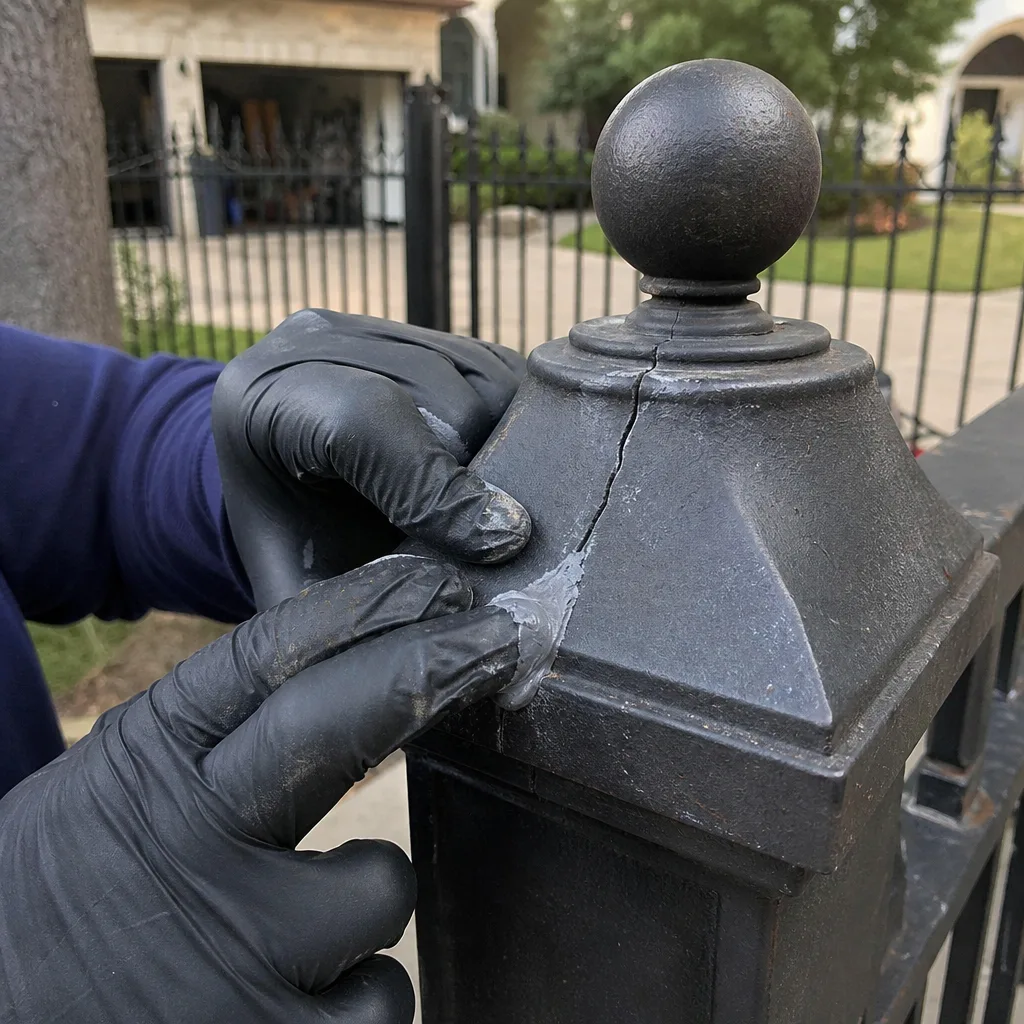
A 10-second video clip gives a technician more diagnostic information than a 10-minute phone description. Done well, it reduces on-site diagnostic time and therefore your bill. Here’s how to shoot video that a gate technician can actually use.
- Wide shot first, 3 seconds. Stand back far enough to capture the entire gate in the frame. Show the post, the hinge or roller assembly, and the full sweep of the gate’s travel. This gives us context for the symptom.
- Run the gate once, without commentary. Start recording before the gate moves. Capture the complete cycle, including the moment of the symptom. Don’t narrate over the sound; motor noise, clicking, and grinding are diagnostic information we need to hear.
- Close-up of the suspect component. After the wide shot, walk up and film the hinge plate, the roller truck, the photo-eye, or the control board for 3 to 5 seconds. Use your phone’s focus lock by tapping the screen.
- Capture the operator model plate. The model number and serial number are printed on a label. A photograph of that label tells us the operator’s brand, model, and age before we arrive.
- Record the symptom in real time, not a re-creation. If the gate reverses on its own, record that behavior as it happens. A re-created attempt often misses the exact condition that triggered the event.
- Send the video before the appointment. Text or email it to the technician’s dispatch. Two minutes of filming can cut 20 minutes of diagnostic time off a service call.
In our experience, homeowners who send a video and a model number get a more accurate phone estimate before we’ve even dispatched a truck. That’s because we can identify the operator, the symptom category, and the likely failure mode from the clip alone.
The Coppell Caliche Problem: Post Lean and Limit-Switch Drift
Coppell sits on a soil profile that most national gate guides never account for. The newer subdivisions near Freeport Parkway and the expanding neighborhoods off Sandy Lake Road were built over caliche, a hardened calcium carbonate layer that sits beneath the surface clay. Caliche is excellent at supporting compression loads and terrible at resisting lateral movement cycles.
Here’s what happens: the gate post is set in a concrete footing. Summer clay expansion pushes against the post from the west side. Winter contraction relieves that pressure. The freeze-thaw cycle between January and March does the same. Over five to eight years, the post leans imperceptibly toward the direction of least resistance. You won’t see the lean from the street. But the limit switch, which is set to stop the gate at a precise point in its travel, now reads that position incorrectly because the gate’s geometry has shifted.
The symptom is erratic limit-switch behavior: the gate closes but rebounds a few inches, or stops six inches short of the closed position and then creeps. The gate seems haunted. The real problem is that the post has moved, the gate is hanging differently, and the limit switch needs re-setting to match the new geometry. Or, if the lean is significant, the post needs to be re-set.
We’ve diagnosed this pattern in Coppell homes where the homeowner had already replaced a control board based on a competitor’s recommendation. The board wasn’t the problem. The post had moved 11 degrees out of plumb, and the limit switch was reading the gate’s position from a post that was no longer where the installer left it.
Coppell homeowners with gates more than seven years old and built on the caliche belts should check their posts with a level every spring, as outlined in our Seasonal Gate Repair Care for Coppell: Year-Round Homeowner’s Guide. A one-degree lean is normal and manageable. A five-degree lean is a structural call. The difference matters because a post re-set is a foundation job, not a gate repair, and it costs more than a limit-switch recalibration.
What Coppell Gate Repairs Typically Cost
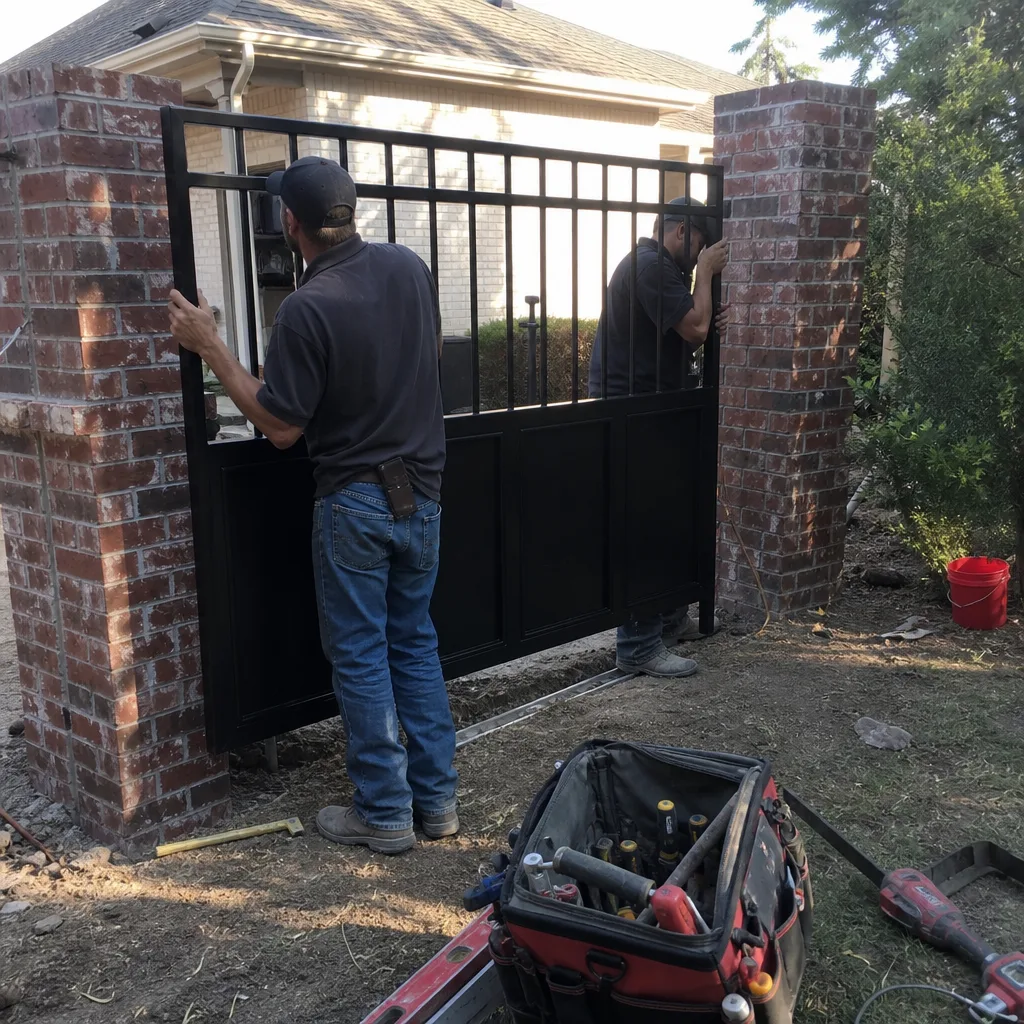
Prices below reflect the Coppell market as of this writing and assume a licensed, insured gate contractor. The range depends on the operator brand, the gate’s size, and whether the damage requires part replacement or can be corrected with adjustment and labor.
- Limit-switch recalibration or replacement: $120 to $260. A simple reset is at the low end. Replacing a failed limit switch on an older FAAC or BFT operator runs toward the high end.
- Photo-eye realignment or replacement: $90 to $210 for realignment. $180 to $340 for replacement, depending on the operator brand and the mounting hardware required.
- Hinge plate weld repair: $350 to $650. Includes unshipping the gate leaf, grinding the old weld, reinforcing the plate, and re-hanging the gate to plumb.
- Start capacitor replacement: $90 to $150. The most common repair we perform on LiftMaster and Mighty Mule operators in Coppell.
- Control board replacement: $450 to $950. Varies by brand; DoorKing and Elite boards sit at the top of that range simply due to component cost.
- Complete swing-gate motor replacement: $700 to $1,100 for the operator, plus $150 to $300 in labor depending on mounting plate condition and whether the arm bracket needs re-welding.
- Post re-set due to caliche-driven lean: $900 to $1,800. Includes excavating the old footing, re-setting the post, new concrete, and full recalibration of the operator and limits.
Every one of these prices should appear on a written estimate before the work begins. If a contractor in Coppell won’t put the price in writing before picking up a tool, that’s a signal. Our position at Vance Gate Repair Coppell home has always been that a written price is a basic requirement, not a courtesy. Under The Haven Standard that we operate by, Clause 1 requires the price be written and handed over before any work starts. No homeowner should accept a verbal number and a handshake on a gate repair, because the component cost range on a control board alone spans $500.
Common Mistakes to Avoid
- Running the gate again to confirm the symptom. Every additional cycle with a known safety fault increases the chance of an entrapment event or component damage. If the gate reversed once, that’s confirmation enough. Disconnect power and call.
- Adjusting limit switches without knowing the manufacturer’s procedure. Each operator brand sets travel limits differently. A LiftMaster swing operator is set differently than a FAAC slide operator. Adjusting blind can over-travel the gate and damage the rack or the post.
- Ignoring a photo-eye fault because the gate still works. A bypassed or failed photo-eye means the gate’s primary entrapment protection is offline. The gate works, but it works dangerously. This is the most common dangerous condition we find in Coppell.
- Treating hinge-plate cracks as cosmetic. The crack is structural. Painting over it makes it invisible, not fixed. The crack propagates underneath the paint and fails when the gate is in motion, not when it’s parked.
- Waiting until the gate fails completely before calling. Complete failures cost more than partial ones because the component that was failing is now destroyed, and typically a secondary component has been damaged as well. A start capacitor failure that’s ignored can damage the control board, doubling the repair cost.
- Assuming the newest operator won’t have sensor drift. Coppell’s temperature swings shift metal frames and mounting brackets. Even a six-month-old installation can have a photo-eye misaligned by two inches, which is enough to trigger false faults or disable the safety circuit entirely.
When to Call a Professional
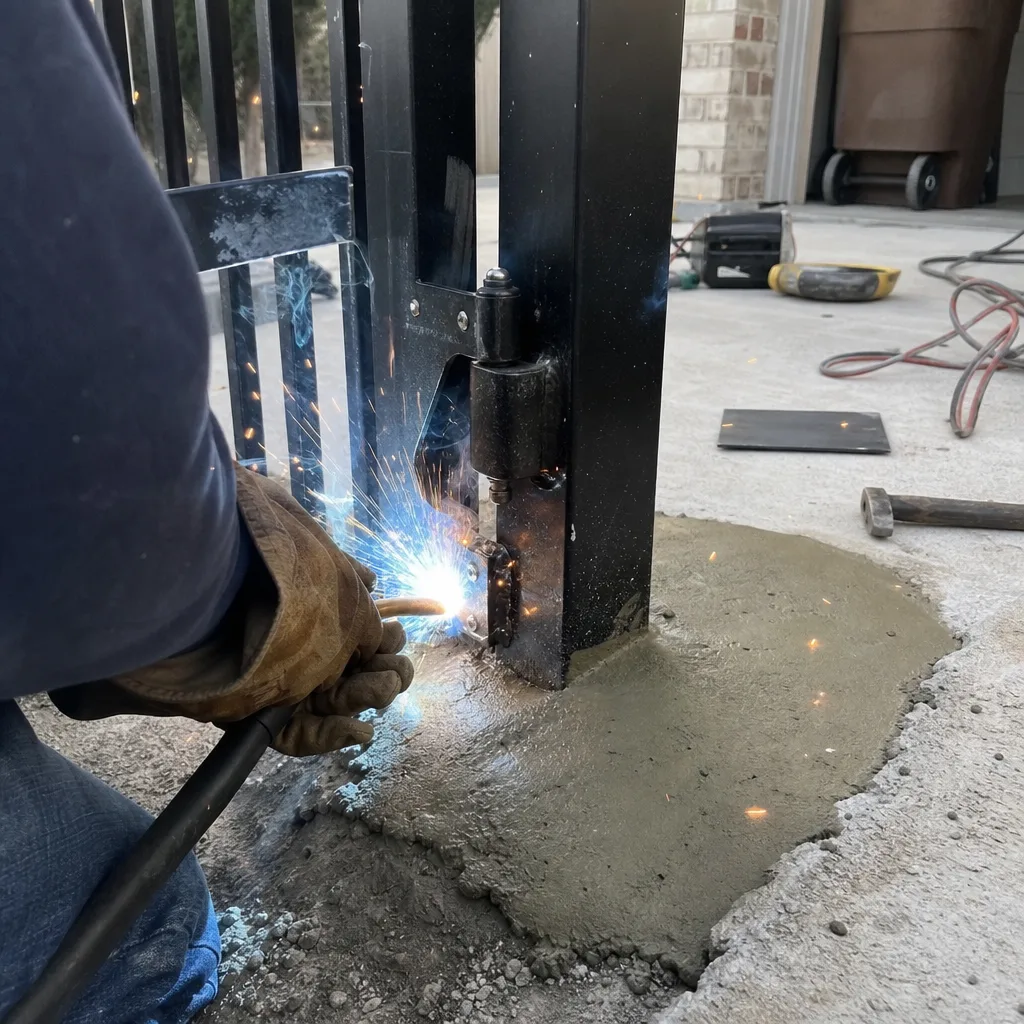
Call a gate professional when you observe any Tier 1 symptom, when a Tier 2 symptom persists through two remote batteries, or when you’ve logged a Tier 3 symptom for more than two months without it stabilizing. Call immediately if the gate has made contact with a person, a vehicle, or a pet, even if no one was hurt. That contact is evidence of a force-sensitivity adjustment problem that will only worsen. If you’re in Coppell and need a diagnosis, gate repair in Coppell is our core service and every visit includes a documented photo record so you can see what we found. Gate motor and opener service in Coppell covers the operator brands most common in this area. Vance Gate Repair Coppell offers free estimates in Coppell, and you can call (817) 674-6552 to schedule one.
Frequently Asked Questions
Serious signs are any uncontrolled movement the gate makes that you did not command, any failure to stop at the end of travel, and any non-working entrapment sensor. Those mean stop using the gate now. Minor signs are speed reduction, startup noise, and surface rust, which you can log and monitor for a few weeks before scheduling service.
Gate reversal in Coppell typically costs $150 to $500 to fix depending on the cause. A limit-switch reset is at the low end. A control board replacement on a LiftMaster or BFT operator lands at the high end. The exact price should appear on a written estimate before work starts, and a technician should be able to explain the diagnosis in plain language.
Yes, most operators have a manual release lever or crank that disengages the motor from the gate. For swing gates, you can then move the leaf by hand. For slide gates, you’ll need to slide it along the rail. Lock the gate in place if you’re leaving the property, and remember that a manually operated gate still has a moving mass that can cause injury if it swings free.
Most residential gate operators in Coppell last 8 to 12 years with proper maintenance. Operators on the caliche soil belts near Freeport Parkway may require more frequent limit-switch recalibration because post movement changes the gate’s travel geometry. A well-maintained LiftMaster or FAAC operator can outlast that range; a neglected Mighty Mule unit in direct sun often falls short of it.
We service nine automation brands: LiftMaster, FAAC, BFT, Linear, Viking, Ghost Controls, DoorKing, Elite, and Mighty Mule. If your operator is one of those, we can diagnose and repair it without steering you toward a replacement unless a replacement is genuinely the more cost-effective option. The written estimate includes the repair path and the replacement path, priced separately.
Disconnect power to the operator at the breaker or the dedicated disconnect switch. Lock the gate in place if it will remain closed, or pin it open if you need driveway access. Do not attempt to operate the gate manually through a symptom you’ve already identified as a safety fault. Take a 10-second video of the symptom if it reoccurs, and photograph the operator’s model plate. That’s everything the technician needs before they arrive.
The Bottom Line
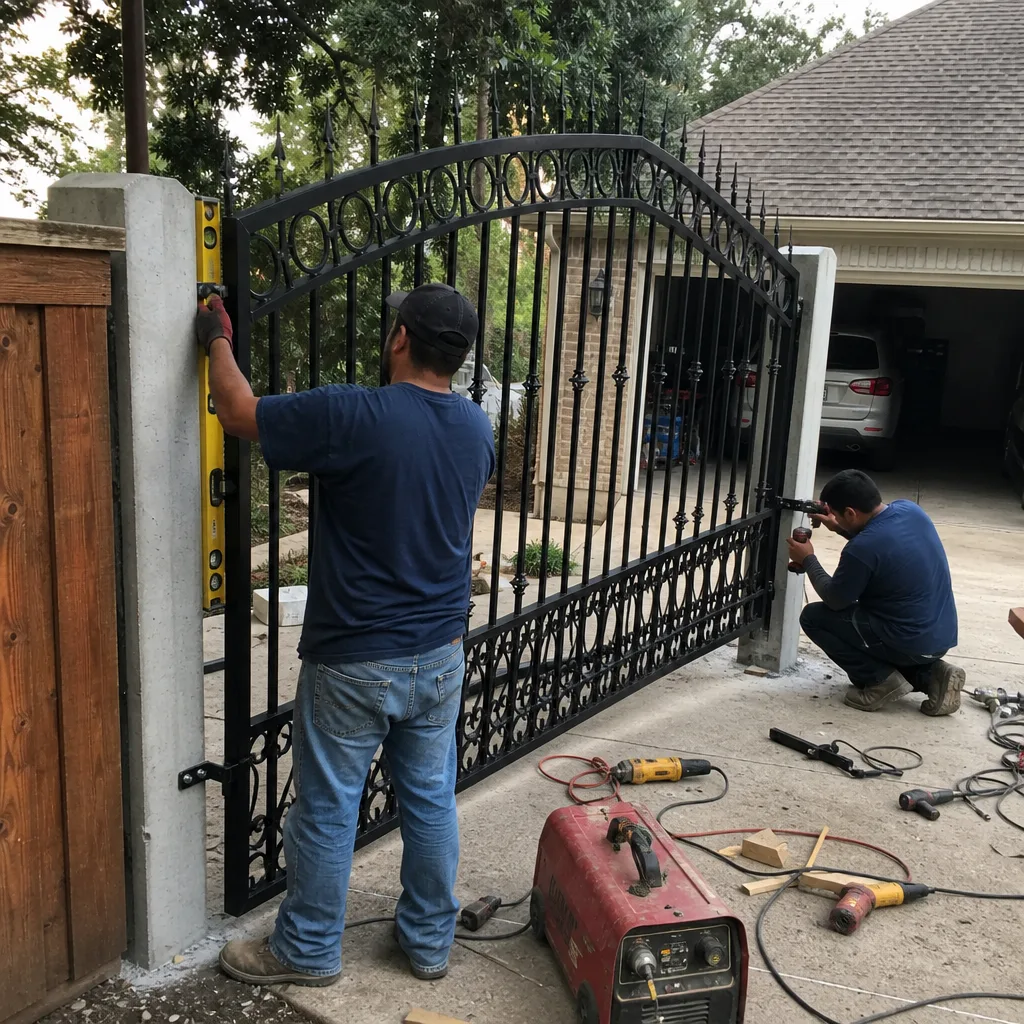
Gate warning signs are not all equal, and treating them as equal is how minor maintenance issues become $1,000 component replacements in Coppell. A gate that reverses, fails to stop, or ignores its entrapment sensors is dangerous today and should be taken offline immediately. Symptoms like slow cycling, startup noise, and surface rust can be logged and watched, but they’re not status quo; they’re data points telling you where the failure will occur. Whatever tier you’re looking at, document it with a phone video and a model number, then get a written price before anyone turns a wrench. For gate installation in Coppell or any repair on an existing gate, the diagnosis should be specific, the price should be on paper, and the evidence should be in your hand before the technician leaves.
Written by Adrian Vance, Owner at Vance Gate Repair Coppell, serving Coppell since 2014.